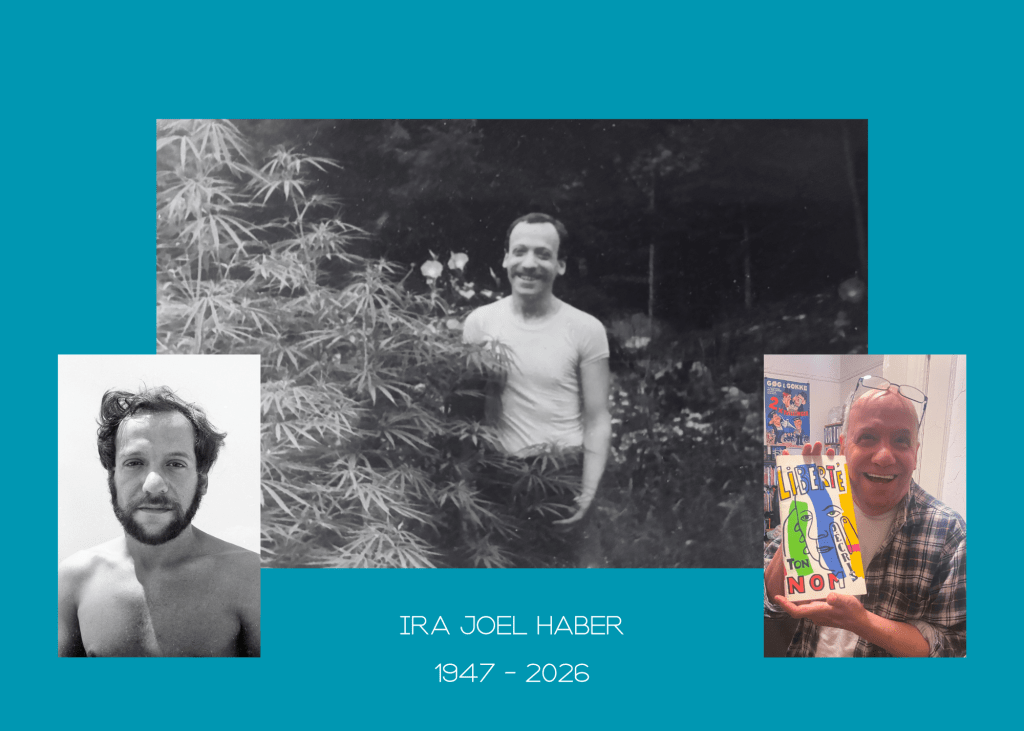
It is with a heavy heart that I announce the passing of friend and artist, Ira Joel Haber. Ira passed away peacefully this morning, July 7, 2026, at a care facility here in New York City. He was 79 years old and a long-time resident of Bay Ridge, Brooklyn.
Stephen Haber, Ira’s nephew in Garden City, New York, announced the passing.
Ira Joel was a prolific artist whose work spanned multiple mediums. His pieces are preserved by storied museums and grace the collections of art lovers worldwide. While his loss is deeply felt, I find comfort in knowing that his work—both visual and written—will live on.
I was fortunate enough to see Ira in action, creating his art while we were roommates from 2022 until late 2025. His studio seemed to expand across multiple areas of his apartment, stretching from the kitchen table and countertop to his bedroom, which he had transformed into an archive of books, art, and supplies. Ira lived a remarkable life, witnessing some of the best and worst moments of the 20th century and the first quarter of the 21st.
Born in Brooklyn on February 24, 1947, Ira was the son of parents who owned a local luncheonette. “My mother would often make food and baked goods at home in the morning to sell at the luncheonette that evening,” he recalled. During his teenage years, Ira exhibited exceptional artistic ability; several of his juvenile pieces are now included in his vast body of work. It was then, in the early 1960s, that his destiny in the art world seemed all but certain.
He was an eyewitness to the Stonewall Riots, passing nearby on the night of the uprising and rushing home to inform his roommates. He later told me that he was once asked to leave Stonewall by the mafia-run management simply because another man touched his hand. A week after Stonewall, he met John Perreault, the renowned poet, artist, and art critic. “My eight years with him were some of the best years of my life,” Ira told me in 2022. Artist Sylvia Sleigh immortalized the couple in a 1970 painting that was exhibited last year at the Brooklyn Museum. A portrait of Ira by Sleigh, titled Pastoral: Ira Joel Haber (1975), is part of the Philadelphia Museum of Art’s permanent collection. Ira once shared a behind-the-scenes photo of Sylvia painting it, laughing, “She wanted me to be nude, but I was too embarrassed, so she painted me with my shorts on.”
In 1969, the same year as the Stonewall Riots, a 22-year-old Ira held his first major New York City exhibition, Street Works III. The following year, both the Museum of Modern Art and the Whitney Museum of American Art exhibited his work. He returned to the Whitney in 1972 for their Biennial, making him the youngest person to exhibit there at the time. During the 1970s, he was represented by the renowned Fischbach Gallery in Manhattan. His work is also included in the collections of the Guggenheim Museum and the Smithsonian. In 1974, 1977, and 1983, he was awarded the National Endowment for the Arts Fellowship.
During his peak involvement in the art world, he survived the AIDS epidemic that wiped out nearly an entire generation of gay men. “I lost so many friends,” he said, recalling that era years later.
His circle of art-world friends included icons like Alice Neel and Andy Warhol. Warhol once called him on the phone and said, “So, I heard you’re burning little buildings these days”—a nod to Ira’s practice of burning scale-model buildings, one of which is housed in the Whitney Museum of American Art.
As an educator, Ira taught across the country, including stints at Kent State University in Ohio and in San Diego, California. He was living and teaching in New York City on September 11, 2001, when he lost a close friend in the collapse of the twin towers.
Ira was also an avid reader and book collector. Just a couple of weeks before he was hospitalized, he sold his extensive collection of rare books to the Strand in Manhattan, ensuring that the volumes he spent a lifetime collecting would find their way into the hands of people who would truly appreciate them. Some items in his collection were so rare that museums around the world purchased them. His library included copies signed by Tennessee Williams—whom he once met at a party—and F. Scott Fitzgerald.
I stopped by the apartment to see Ira in mid-April. He was painting but wasn’t feeling well. Still, he was surrounded by his art and his vast collection of movies, which is exactly where he preferred to be. On April 30, Ira checked himself into the hospital due to severe pain and fainting. In a voicemail, he told me doctors had discovered cancer in his lung. Later, in an email sent from his hospital bed a month before his passing, he shared that his room was quiet and peaceful. “I just received a blood transfusion,” he wrote. “Time doesn’t exist. Most of the nurses are swell.”
In mid-June, he was transferred to a rehabilitation center, where I was able to visit him on June 23. We spoke of the usual topics we always returned to before, during, and after our time as roommates: art, movies, and politics. He looked through some of my recent photographs. He had lost a significant amount of weight, but if you knew Ira, you knew he was still cracking jokes about not having pants on and reaching his goal weight for the summer beach season.
In our parting moment, he said to me, “Monty, I know this is the beginning of the end, and I’ve accepted that.” Despite his fragile state, he hugged me. I told him I loved him.
Ira was preceded in death by his parents, Rosalind Tilzer (1916–1994) and Oscar Haber (1914–1987), as well as his sister.
May his memory be a blessing.
— Montgomery Maxton

