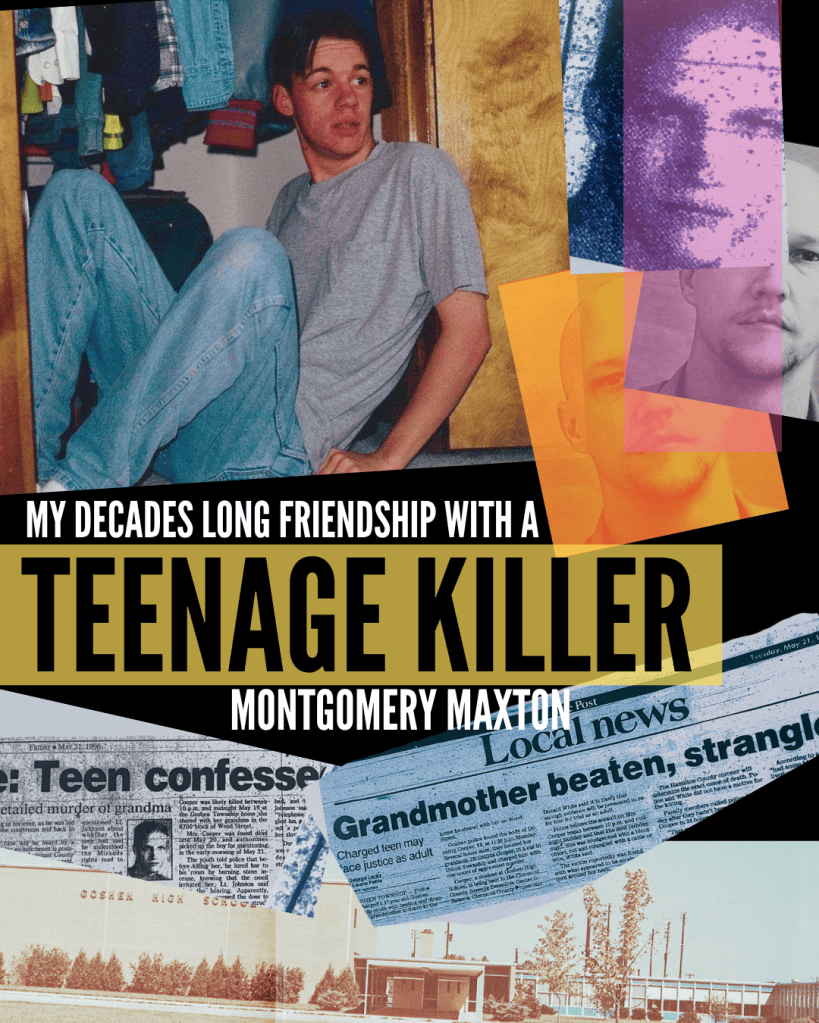
People are often stunned when they find out that one of my longest-term friendships is with a man who is serving a life sentence for murder. Starting today, I am opening up about a part of my life I’ve kept private for decades, sharing the story of a 30-year friendship that began in our youth and survived the unthinkable: murder, a teenage fugitive on the run, and life in prison.
While true crime often leans into sensationalism, that isn’t what you’ll find much of here. These essays are a reflection on two paths that diverged from the same small town—and how, through weekly conversations, our connection remains, some 30 years later.
Beyond telling our story, this series grapples with a larger question: should we ever lock children away forever and will I champion his parole in 2027? This is part one of the story of how we got here.
JR COLLINS COOPER AND MONTGOMERY MAXTON: TEENAGERS IN A SMALL TOWN
It was the end of the school year, in 1996, my freshman year of high school. Our small town in rural Ohio, about 30 miles east of Cincinnati. I had virtually failed the entire year. The bullying was so severe I couldn’t participate in classes; I was too afraid to speak, I’d do anything not to attend school.
The worst class of all for bullying was by far gym class, which is where I met JR Collins Cooper, a 17 year old third year freshman (JR is his first name, simple letters that are not initials for additional names, it is not pronounced Junior, it is pronounced as the letter J and the letter R). I had never seen him until that school year began. On the first day, back in the August heat of 1995—no air conditioning in the overcrowded school that was situated in a cornfield, baking in the summer sun all day long—the gym teacher, a popular sports coach who was slightly beyond his athletic prime yet still retained good looks and a masculinity that in today’s term would be described as toxic—said to the boys gym class, “If you have no plans to participate in this class this year you can sit on those bleachers, out of everyone’s way who wants to take this class seriously, and I’ll happily fail your ass.” Cooper got up, walked over and sat down. Coach, familiar with Cooper and having failed him for the last three years, watched as the 6 and a half foot tall, dirty blonde, lean albeit muscular teenager in his cowboy boots and somewhat tight stonewashed jeans climbed up the bleachers to the top bench, sat down, and looked down at his feet; bored, disconnected. Two other boys, both notorious potheads in Nirvana and Metallica t-shirts so large they looked like dresses, took spots on the bleachers, away from Cooper.
Hoping to avoid being beaten, taunted, shoved, and assaulted in the locker room as I had been for the last couple of years in Junior High School, where those same bullies were in this very gym class as well as boys from the class years ahead of me, I stood up and began my walk towards the bleachers, a “faggot” echoing in the silence of the gym as everyone watched me take a seat near Cooper.
“Hey,” I said. “Hey,” he replied back, his voice deep and somewhat exotic. For the next year, we sat on those bleachers together.
Goshen, Ohio is not like the towns that surround it. While its neighbors Milford, Ohio and Loveland, Ohio thrived, Goshen struggled with bringing in businesses; Ohio refusing to widen the two lane state route that cut through the town part of the reason. Many residents were poverty stricken, as evident with its number of trailer parks and shack-like homes that dotted the rural-suburban landscape that make up the 34 square mile town. The school system was, at the time, noted for is poor performance, high drop-out rate and high teen pregnancy rate. There was farmland in one area of town and hollers in another. Throughout, fire and brimstone churches of the Southern Baptist and Pentecost faiths performed sermons weekly about the sins of life.
Cooper lived with his grandmother Dorothy on Wood Street, in a ranch-style house from the late 1960s that was nearest the town center which held, at the time, just a gas station and convenience store, and down the hill a bank and a rundown grocery store a relic from the 1970s. Across the street, the police department and fire station. Cooper lived so close to the school that he could walk, and often did, my school bus passing him as he trudged through the grass and ditches, as on that side of town there were no sidewalks. To be honest, I don’t think bus routes were scheduled on his street, as it was so close to the schools, despite the wet and muddy path to get to it. Several girls would remark on his handsomeness as my bus drove by him. I also had taken note of his physical appeal from the getgo and, being gay though not publicly out, had secretly wished he was my boyfriend.
I’ve never known the amount of time Cooper lived with Dorothy, though media would later say she pretty much raised him. I do not know why his mother and father were not in his life at that time, or what kind of house Dorothy kept in terms of discipline. Yet, with Cooper so behind in his school years, I would imagine it wasn’t very encouraging of education.
While my days at school were horrible, my home life wasn’t as severe. After living in Milford since my birth in 1980, my parents returned, in the late 1980s, to Goshen, their hometown, where they were somewhat almost high school sweethearts (they knew each other then, but did not date until just after graduation, when they met again during a chance encounter some miles from the town). In the early 1990s they built the house I would grow up in during my teenage years. A sprawling six acre homestead with woods, meadows, and fields, complete with a beautiful two story modern partially bricked house, with a two car garage, four bedrooms and three bathrooms, and a swimming pool. Despite starting their family in poverty (on my first birthday they had $6 in their checking account, an old checkbook would later reveal to me) they had worked hard and seemingly non-stop, my father at Ford Motor Company and my mother at Macy’s headquarters in Cincinnati, to eventually be able to afford a slice of the so called American dream. By the time I started, and ended, my freshman year, we had lived in the house that I called Ivy Manor after the insane amount of poison ivy and poison oak on the property, for three years. We enjoyed two, sometimes three vacations away each year, new cars, and dinners out several times a week, which was my much needed escape from the town of my bullies. Though it sounds bucolic, it wasn’t so much. My brother was a redneck jerk who frequently beat me up the way such brothers do, and my father had not idea what to do with me, and the idea of me being homosexual perhaps disgusted him. Cracks in my parents marriage were starting to show, caused by my father’s suspected infidelity.
On Monday, May 20th, 1996, Cooper did not show up at school. We had just a week and a half left of the academic year and the end could not come soon enough. Not only would it mean a two and a half month reprieve from the bullying, it also meant more time to be in the swimming pool and a family vacation planned for the mountains of Tennessee. It would also be the summer I turn 16, though I had no plans to get my driver’s license, as that would mean getting a job. It would be the summer that I began writing poetry and doing photography.
The school day came and went. That evening I had dinner with my mother and sister, then retired to my room to watch the news and then David Letterman’s show before falling asleep. Returning the next day the story was breaking news. Television stations from Cincinnati and Dayton were in town. Cooper was on the run, his grandmother’s body found brutally murdered in her house after a concerned family requested police perform a welfare check.
I sat in gym class, shocked by the news. Bullies taunted me, asking me where my boyfriend was, using sexually vulgar and homophobic language. One boy, whom would later go to prison himself for the murder of a person, said, “maybe next he’ll do us all a favor and kill your faggoty ass.”
While police never questioned me—and I knew nothing about the build up to the event and Cooper’s danger festering underneath, the details of the crime was horrifying, shocking everyone.
Dorothy was found strangled to death, a phone cord wrapped around her throat, which had also been slit from ear to ear with a butcher knife. In addition, she was also struck over the head with great force with a blunt object. Police said she was killed Sunday night, May 19th, and Cooper fled at some point after.
He did not stop by Ivy Manor as he fled town. While he knew where I lived, he had never visited. It is perhaps the greatest blessing in disguise I have ever been given. Being so bullied and abused, and with such isolation in that town, yearning to be somewhere else, I may very well have gotten in the stolen car with him.
Part 2 coming in October 2026

